By the time most men notice thinning,
30-40%
is already gone
Not because they ignore it — but because early-stage thinning
doesn't look like hair loss.
It looks like lighting. A different angle. A bad hair day. But by
the time it becomes obvious, several 90-day cycles have already
passed.
And those cycles don’t pause while you figure it out.
What most men notice first
It usually shows up in a photo
Not the mirror — photos catch things differently.
A certain angle. A certain light. Something feels slightly off.
This is usually not the beginning. It's just the moment you
noticed.
If you've noticed your crown looks different under certain lighting —
that's not the lighting. If your temples look slightly different in
photos than they do in the mirror — that's not the angle. If it feels
inconsistent rather than obvious, like some days it's fine and some
days it isn't — that inconsistency is itself a signal.
"Wait... was it always like this?"
For most men, that moment is the first honest acknowledgment that
something has begun to change.
If that thought has crossed your mind, you're not imagining it. What
you're noticing is the visible surface of a biological process that
started quietly, well before you became aware of it.
This is where most men get it wrong. They notice something, question
it briefly, and move on — telling themselves it's stress, or styling,
or bad lighting. Meanwhile, the biology keeps moving on its own
timeline.
Because while you're trying to make sense of it, the biology is still
moving — on its own timeline, at its own pace.
Most men only realise this later. The ones who don't are the ones who
understand which stage they're actually in early enough to respond
properly.
You can't determine your stage from the mirror. But you can determine it
in under 60 seconds.
See what stage you are already in
Based on your specific pattern · Not a generic result
Check my stage now
Takes about 60 seconds · Free · No product recommendations
yet
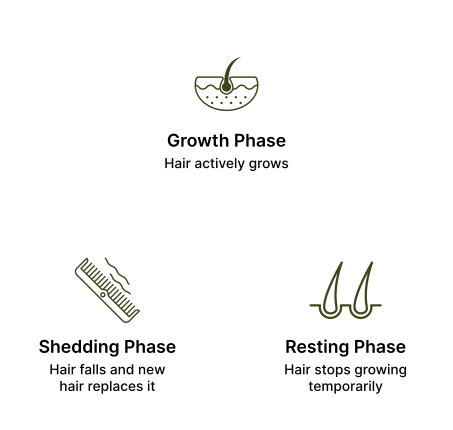
Hair Growth Cycle
Hair thinning doesn’t happen randomly. It follows a cycle.
There's a growth phase, where the follicle actively produces hair.
A resting phase, where production pauses temporarily. And a
shedding phase, where the old strand releases and the cycle begins
again.
In a healthy follicle, the growth phase dominates — lasting
anywhere from two to six years. The resting and shedding phases
are brief.
What disrupts that cycle — and why it matters
When a follicle becomes sensitive to DHT (dihydrotestosterone) — a
hormone derived from testosterone, naturally present in all men —
the growth phase gradually shortens. Hair grows back finer, weaker,
less consistent.
This usually starts long before you can see it. Which usually
means by the time it looks like thinning, the cycle has already
shifted.
This doesn't happen all at once. It happens cycle by cycle —
quietly — until the change becomes visible. Which is why the most
important question isn't just whether this is happening.
It's: which stage of that process are you currently in? Because
that determines what actually helps — and what doesn't.
Key distinction:
Early-stage thinning doesn’t stop growth. It produces
weaker, finer hair, cycle after cycle. That why it's easy to miss.
This means the window to support them remains open — but the
size of that window depends on which stage you're in.
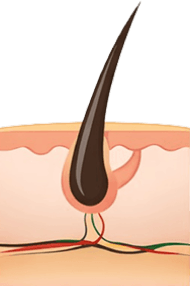
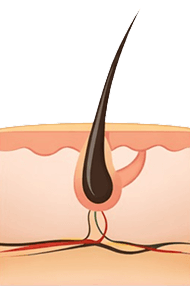
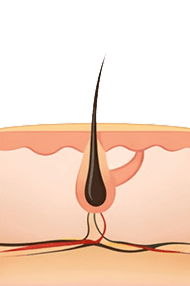
This does not happen all at once, it happens cycle by cycle
Healthy Hair Follicle
DHT-Affected Follicle
Prolonged DHT Effect
Dormant Follicle
Where you are in this progression determines what actually helps
next
The pathway most active at your stage determines what actually
helps. And you can’t determine that from the mirror.
See what stage you're already in
Based on your specific pattern · Not a generic result
Hair thinning progresses through three distinct stages
From the outside, they can look almost identical. Biologically,
they are not. And this is where most approaches fall short —
treating the visible surface without understanding which stage is
actually driving it.
Early Stage
Follicles still active. Growth phase beginning to shorten.
Changes subtle — mainly visible in photos
Progressing Stage
Visible density changes. Follicles still present — producing
weaker output each cycle.
Advanced Stage
Multiple shortened cycles. The approach that supports recovery
looks different here — more focused, differently sequenced.
Here's the problem: Most men think they are in an
early stage, when they are already progressing. That is where months
get lost.
Here's what misidentifying your stage actually costs: a full 90-day
follicle cycle spent addressing the wrong pathway. Each cycle that
passes moves on its own timeline — whether you act on it or not. The
men who eventually see results almost always trace it back to one
moment — when they stopped assuming their stage and confirmed it.
Each cycle you miss makes recovery harder
Don’t lose another 90-day cycle
Takes 60 seconds · Shows where you actually are · No guesswork
Most men don't ignore thinning,
they just misread it
It usually starts with a simple explanation.
It must be the lighting
I've been under a lot of stress
It's just how I'm styling it
It will come back on its own
So the response becomes reactive:
Switching shampoos
Trying oils
Adding a supplement
Doing something — anything — that feels like progress
Hair thinning involves multiple biological processes — DHT sensitivity
affecting growth duration, scalp environment affecting follicle
stability, and disrupted growth cycles affecting output consistency.
The stage you're in determines which of these is most active right
now. Targeting the wrong one — even with something that works — means
the approach is structurally incomplete. Not because the effort was
wrong. Because the sequence was.
That's not a failure of effort. It's a mismatch between the solution
and the stage.
Each 90-day cycle passes whether you act on it or not.
Knowing your stage means you're not spending a full cycle on the
wrong pathway.
The fact that you're here — reading this, trying to understand
what's actually happening — already puts you on a different
path.
Most men respond to thinning by switching products. Very few
take the time to understand the biology first — let alone
identify which stage they're actually in.
Knowing your stage changes everything about what comes next.
Identify which stage you are actually in.
Without that, anything you try is still guesswork against a
biology that keeps on moving.
Identify my stage
Takes 60 seconds · Shows where you actually are · No guesswork
The approach that works isn’t more effort. It’s the right sequence.
Most men who eventually see results don’t do more than the men who don’t. They do something different: they address all three biological processes — in the right order, consistently enough for the follicles to respond across 90-day cycles. Not one pathway. Not two. All three. In sequence. This is where most approaches structurally fail — not because the ingredient is wrong, but because the sequence is.
Stop. Interrupt the DHT binding process shortening the growth phase.
Secure. Stabilise the follicle environment that determines output.
Stimulate. Create the conditions for the growth phase to begin normalising.
Each requires a different form of support. Together, consistently, over a full 90-day cycle — this is what structured recovery actually looks like.
The specific approach that works for your pattern depends on which of these three processes is most active at your current stage. A man in early stage has a different primary pathway than a man in progressing stage. Addressing the wrong one — even with something clinically sound — is still an incomplete response. That’s why stage identification comes first. Not as a formality. As the foundation. You can’t determine your stage from the mirror. But you can determine it in under 60 seconds.
What a structured response looks like
Hair recovery doesn't follow a marketing timeline. It follows a
biological one.
Hair follicles operate on 90-day cycles. Changes accumulate across
those cycles, not within them. This is why approaches that promise
rapid results consistently disappoint — they're working against the
biology, not with it.
D 1
Internal shift begins
Follicles encounter a new supportive environment. No visible
changes — this phase is entirely internal and cellular.
D 30
Scalp environment begins to respond
Circulation, sebum balance, and inflammatory environment begin
adjusting. Still no visible change. Most men give up here.
D 60
New follicle cycles begin forming
Some follicles re-enter the growth phase beneath the scalp.
Output is not yet perceptible.
D 90
Changes become assessable
Enough cycles completed that texture, density, and shedding rate
changes become observable. This is the minimum meaningful
evaluation window.
This is the minimum window where meaningful change can be assessed.
Anything shorter often leads to false conclusions.
That's what structured hair recovery actually looks like
Not more effort. The right structure — matched to your stage.
Each 90-day cycle passes whether you act on it or not. The stage
you're in, the location of the change, the pace — these determine
which biological pathway is most active right now. You can't determine
that from the mirror. But you can determine it in under 60 seconds —
and get a specific report identifying your stage, your dominant
pathway, and what that means for what comes next.
Identify my stage
Your report includes: your stage · your dominant pathway · a
structured path forward